2025 HTCondor European Workshop Showcases Advances in High Throughput Computing
Sophie Dorros
Dec 03, 2025
Showcasing both technical advances and real-world applications of HTCondor, the 2025 HTCondor European Workshop was held at the Institute of Physics of the Czech Academy of Sciences (FZU) in Prague from September 16-19.
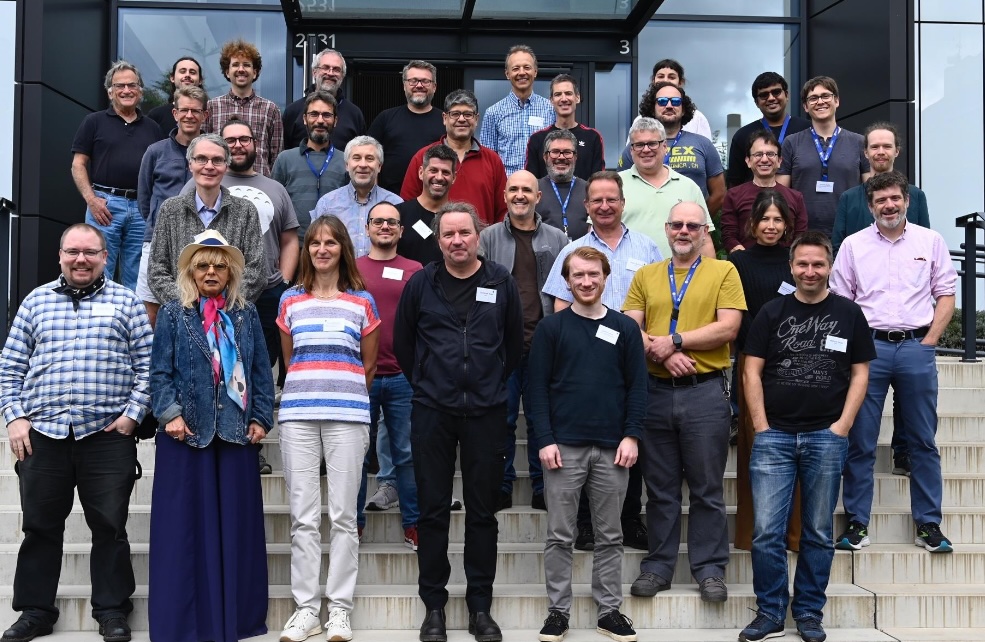
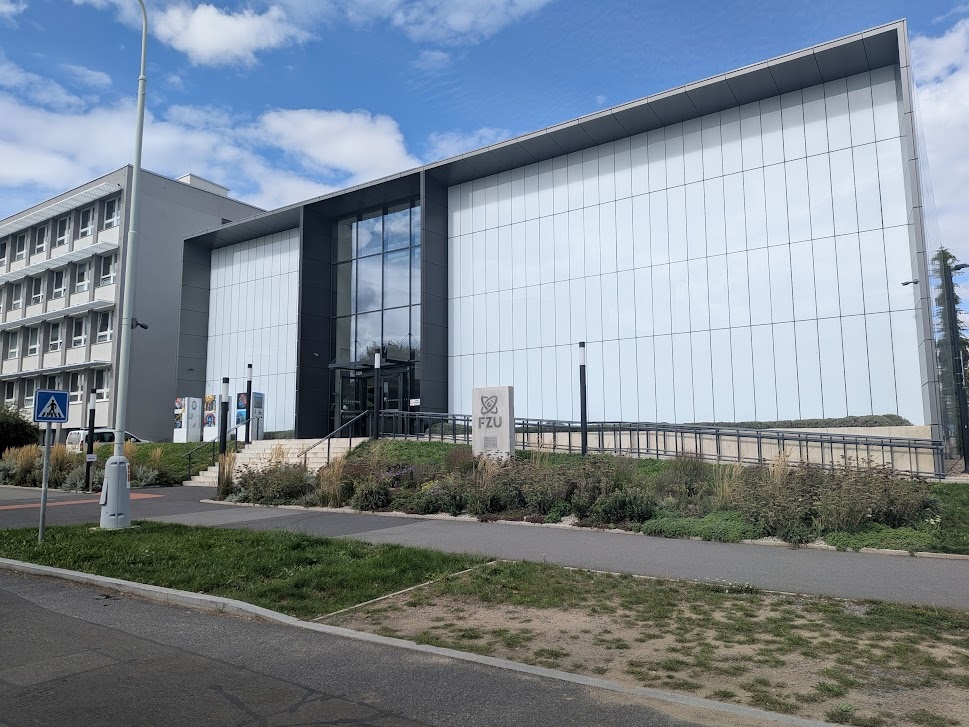
Group Photo of Workshop Attendees, Pictured: The Institute of Physics of the Czech Academy of Sciences (FZU), Credits: Greg Thain
The 2025 European HTCondor Workshop brought together European and American HTCondor users and developers to collaborate and advance innovation in high throughput computing. The 2025 workshop provided an opportunity for increased connection and community among HTCondor users and developers, and is a key event in showcasing the technical advances and real-world applications of HTCondor.
This year’s workshop was held in Prague at the Institute of Physics of the Czech Academy of Sciences (FZU), from September 16-19th. HTCondor is a software suite developed by the Center for High Throughput Computing (CHTC) at the University of Wisconsin-Madison to utilize the power of a network of clustered computers, splitting tasks into simultaneously running self-contained tasks, which then provides results that could have taken months or even years to complete using a singular system.
With the upcoming scheduled shutdown of the Large Hadron Collider, the world’s largest and most powerful particle accelerator managed by the European Organization for Nuclear Research (CERN) and stored, distributed and analyzed by the Worldwide LHC Computing Grid (WLCG), much of the workshop centered around preparations for the increased amount of data that will come as a result. The WLCG distributes almost 200 petabytes of data a year from the LHC in need of computing to compute tiers in different nations, like the US, UK, France, and Italy, who help process and compute. A majority of participants of the European HTCondor Workshops are involved in running compute tiers for the WLCG, making the operations of the LHC and WLCG a prime focus for attendees. Graphics Processing Unit (GPU’s) usage was also a focal point.
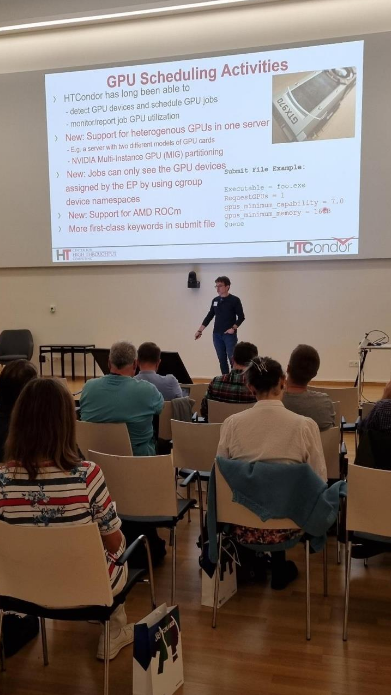
Popular workshops presented by CHTC representatives included: Tour of all the HTCSS Tools, or the “Show your tool box” session, where participants are free to stand up and give lightning talks on their HTCondor usage, and the Scheduling and Policies Theme session where users share how they set up HTCondor to decide when to run jobs and evaluate if a compute node is working. Miron Livny (Director of CHTC), Todd Tannenbaum (HTCondor Technical Lead), Greg Thain (HTCondor Core Developer), and Brian Bockelman, (Pelican Platform Principal Investigator), attended the workshop on behalf of the CHTC this year.
The CHTC joined colleagues from 10 countries, representing a range of organizations, spanning from government labs, to universities, to industry. HTCondor technical lead Todd Tannebaum noted that “This [event] is initiated by the European community, it’s driven by the European community, the agendas decided upon by the European community.” And this year, the needs of the European HTCondor user community are growing massively. The Long Shutdown 3 (LS3), the scheduled maintenance for the LHC, is set to begin at the start of 2026 to prepare for “Run 4” or the fourth cycle of the LHC. LS3 will transform the LHC into the High-Luminosity LHC (HL-LHC), creating more particle collisions per second and increasing the amount of data able to be collected. Currently, there are 125,000 running jobs, and Run 4 will require that capacity to run almost 500,000. The Can we break HTCondor before HL-LHC Does presentation given by Antonio Delgado (University of Notre Dame) and Ben Jones (CERN) concluded that scaling to almost 500k jobs seems possible, a promising sign for the advancement of LHC data collection and processing assisted by HTCondor.
Dr. Chris Brew, particle physicist and grid computing expert at UK Research and Innovation and Organizing Committee Chair, noted that the event is structured to create an environment of community building among HTCondor users and to increase interactions between users and developers. Brew and other organizers have gradually been implementing more “structured open discussion sections,” like the Share your Toolbox Session, to encourage people to stand up and discuss their experience as users. “People enjoy them and lots of people talk and show what they’ve got,” said Brew. The social aspect of the week remained a focus for organizers this year. Brew noted that “Giving people time outside the scheduled sessions just to get together and talk to each other without doing it as a session, it’s very important.” Fairly long breaks are structured into the event which gives attendees time outside of formally scheduled sessions to network in a more casual setting. These coffee breaks are key in building a stronger connection between participants and developers according to Brew: “It’s a lot easier to ask for help from somebody if you’ve had a coffee with them, you’ve chatted to them.”
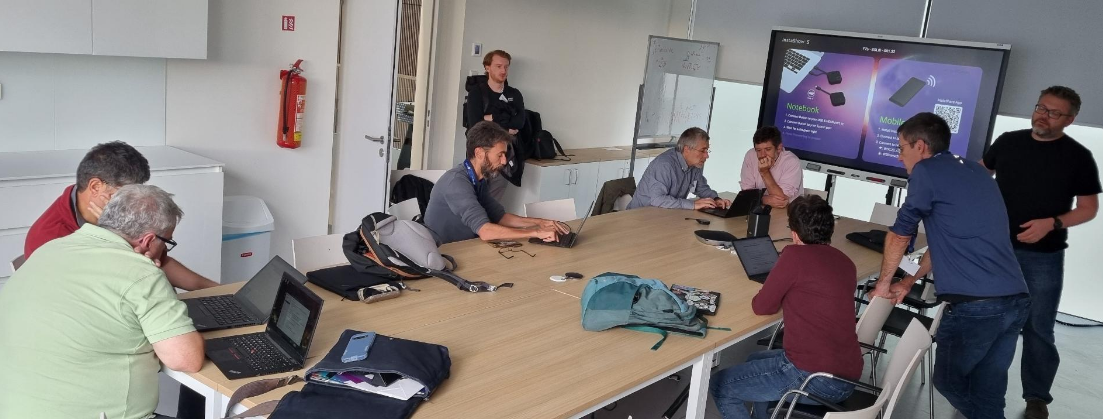
The tight-knit hands on atmosphere of the European workshop is important to facilitate peer to peer discussion. HTCondor Office hours remained very popular and well attended this year, with two sessions led by CHTC staff Todd Tannenbaum and Greg Thain. “A large part of our research is understanding the real problems that real users have…and we need the inputs of users to understand what their problems are,” noted Thain. Office hours are an opportunity for HTCondor developers to understand the issues of real HTCondor users, which is important for internationally shared resources, like the LHC, which depend on international collaboration in science.
An exciting development coming out of this year’s workshops is that CHTC will now be hosting virtual office hours, open to European or American users starting in 2026. Rather than solely serving as an opportunity for users to talk to HTCondor experts about HTCondor, these office hours will also serve as an information sharing network between HTCondor users across the globe, facilitating peer to peer discussion and allowing for faster, more efficient streams of information.
The 2025 HTCondor European Workshops boosted connections between developers and users and helped solidify the reach and understanding of HTCondor in Europe. A full overview and timetable of the week can be found at the workshop site here.